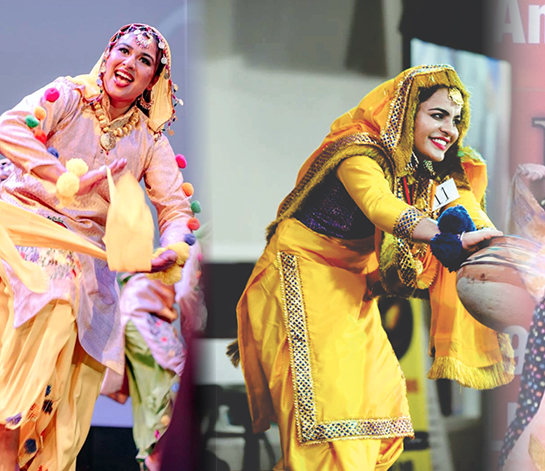
The coequal to male Bhangra, giddha is a female folk dance from Punjab. It is an enthusiastic dance emanating from ancient ring dancing that highlights feminine grace and elasticity. It is often escorted by singing folk couplets known as bolliyan. Giddha is a classic Punjabi dance conducted by women. It is often performed at weddings and other celebrations and involves a lot of spinning, clapping, and footwork. The dancers wear dazzlingly colored ensembles and often sing along to the music.
The menfolk of Punjab dance Bhangra while the womenfolk perform Gidda. It is performed on all joyful occasions like marriage and childbirth. The ceremonial Gidda, nevertheless, is danced for consecutive twelve days in July when the festival called Teejan of Sawan is held. The dance consists of singing, clapping, and enacting the Boli, which is one or two couplets that narrate a very wide range of topics from family chores to the strains between mother-in-law and daughter-in-law: The singing of the Boli is punctuated with an enthusiastic refrain-phrase Balle, Balle.
To perpetrate Gidda the dancers form a circle and participants in duos, take turns to arrive at the middle and sing the boli. Towards the end of the boli the pair dance with gay abandon and then return to the circle. Another pair replaces them. Thus the dance may persist for hours. Constantly the dance is accompanied by a Dholak played by one of the women participants. At times it is danced only to the clapping. Gidda is uniformly popular in Punjab, however, the Gidda of Malwa area is famous for its gusto and speed.